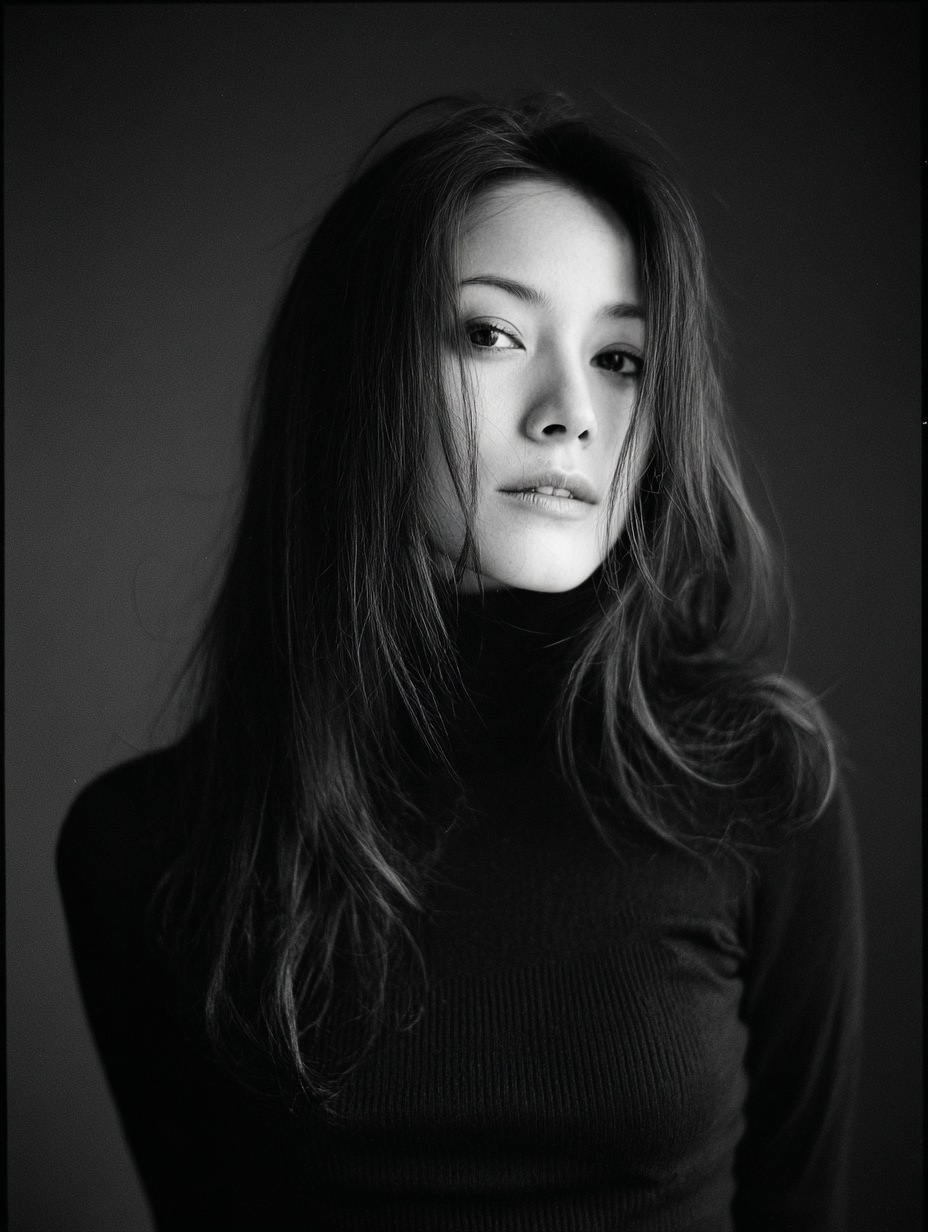
She had started the painting at six and at eleven she was still at it. The rice paper was spread on the low table where she always worked, four sheets joined edge to edge, and she sat on her heels at the corner with the brush held just above the surface, deciding. Mount Fuji, again. It was the hundredth time, perhaps the hundred and tenth.
Outside, the cherry in the courtyard had not yet opened. A boy passed on a bicycle with bread in the basket. The window was just open enough to admit the sound of the spring without the cold of it, and the smell of ink and the smell of earth came in together, as if neither could enter alone.
Her phone, turned face down on the tatami beside her, had received three messages from her mother since the hour of the mouse. None of them required an answer and all of them, taken together, required a decision. She had not yet looked at them. She would look at them, she thought, when the mountain was done.
The mountain, of course, was never done. She had understood this at twenty — had understood it properly at thirty — and now, at thirty-five, it had begun to feel less like a failure of painting than like a property of mountains. Fuji was not a thing one finished. It was a thing one kept company with, over years, the way one keeps company with a friend who says very little and whose silence is the whole of what one loves in them.
She dipped the brush. She paused. She set it down.
"Later," she said, to no one, to the room, to the mountain.
On the windowsill, the bonsai had put out three small green shoots, no larger than the nail of her smallest finger. She had not yet decided whether to cut them.
Across the city, in a building of glass and polite concrete, Julien Lambert was looking at the thing he had made and trying to feel something about it. On the wall behind him, the praise had already been framed. His colleagues had begun to speak of him in the voice they reserved for departures.
He stood with his hands in his pockets, which was a habit from Lyon and not, he had come to understand, a habit shared by the country in which he now lived. Through the window the Yamanote line made its slow loop, carrying, as always, a great many people who had somewhere to be.
He had been in Japan for ten years. He had arrived in March and it had been snowing, which had seemed to him, at twenty-six, a kind of promise.
The thing on the wall was a chair. It was, by any measure he had been taught to use, a good chair. It sat where it should. It held what it should. It had been photographed in the right magazines, in the right light, by a man who charged too much and whose pictures had the careful, slightly sorrowful beauty of objects that have been asked to mean more than they are.
He had not slept well. He had slept, but not well, which was a thing he had begun to distinguish between.
On his desk, the drawings for the next thing waited, patient as the drawings always were. He knew, looking at them, that he could do it. He was less sure, lately, whether he wished to.
Stay, or go. It had become, in his mind, less a question than a weather.
The gallery was in a street she had walked since she was a student, and it had changed hands three times in the years since, and each time it had become a little more like itself. The woman at the desk knew her by sight and not by name, which Hana preferred.
There were six paintings, all of them the same room, and the room was a kitchen in the north of Kyoto where the painter's grandmother had cooked, and where, in the last of the six, she was no longer there. You did not need to be told this. The paintings told you.
Hana stood a long time in front of the last painting. She did not cry. She had learned not to cry at paintings, which was a different thing from not being moved by them.
When she turned, there was a man standing at a careful distance, looking at the fifth painting with the particular stillness of someone who has decided not to be in a hurry. He was tall and slightly thin, in the way of men who have forgotten to eat, and he wore his foreignness lightly, as a coat he had owned for a long time and no longer noticed.
They did not speak. They stood in front of their paintings. After a while, without looking at her, he said, in careful Japanese, "It is the light in the fifth one."
"Yes," she said.
Neither of them moved. Outside, it had begun to rain in the way that spring rains in Tokyo, which is to say as if apologising.
Later, she would not remember what they had said to each other in the half-hour before they left the gallery, only that she had not looked at her phone, and that she had answered, when asked, that yes, she was a painter, and that no, she did not show.
She would remember, though the memory would refuse to arrange itself neatly, that he had walked her three blocks in the wrong direction and then, realising, had laughed without embarrassment. She would remember that he smelled faintly of cedar, and of the inside of an office, and of something else she could not place and did not try.
At the corner of the main road, they had stopped. He had not asked for her number and she had not given it. He had said, "The light is very kind to you," which was a strange thing to say and not, she thought afterwards, strictly a compliment.
She had nodded. She had walked home in the rain. The rice paper was still on the low table where she had left it, and the mountain was still unfinished, and the bonsai had, in her absence, put out a fourth small green shoot.
She did not cut it.